
GPT-5.6: OpenAI's Most Powerful AI Model Yet
June 26, 2026
GPT-5.6 is OpenAI's most anticipated model release of 2026 — and it's already stirring controversy before reaching the public. With reported breakthroughs in context handling, coding accuracy, and multimodal reasoning, GPT-5.6 may redefine what AI can do for everyday professionals.
In this guide, we break down everything you need to know: what GPT-5.6 actually does, why the US government stepped in to delay its release, and how to pair it with tools like iMini AI to get the most out of the next generation of AI.
What Is GPT-5.6?
GPT-5.6 is OpenAI's latest limited-preview model series, officially released in late June 2026 for trusted partners and developers to test. The series now includes three sub-models: Sol, the new flagship model with top-tier reasoning and intelligence; Terra, the balanced model that targets GPT-5.5-level performance at a lower compute cost for everyday work; and Luna, the fast, affordable model built for high value and quick responses.
OpenAI CEO Sam Altman has confirmed that GPT-5.6 underwent a government review process before launch, making this one of the most scrutinized AI releases in history. The model's capabilities — particularly in automating high-skill technical work — raised enough red flags to trigger a phased rollout rather than an open public launch.

The Evolution from GPT-3 to GPT-5.6
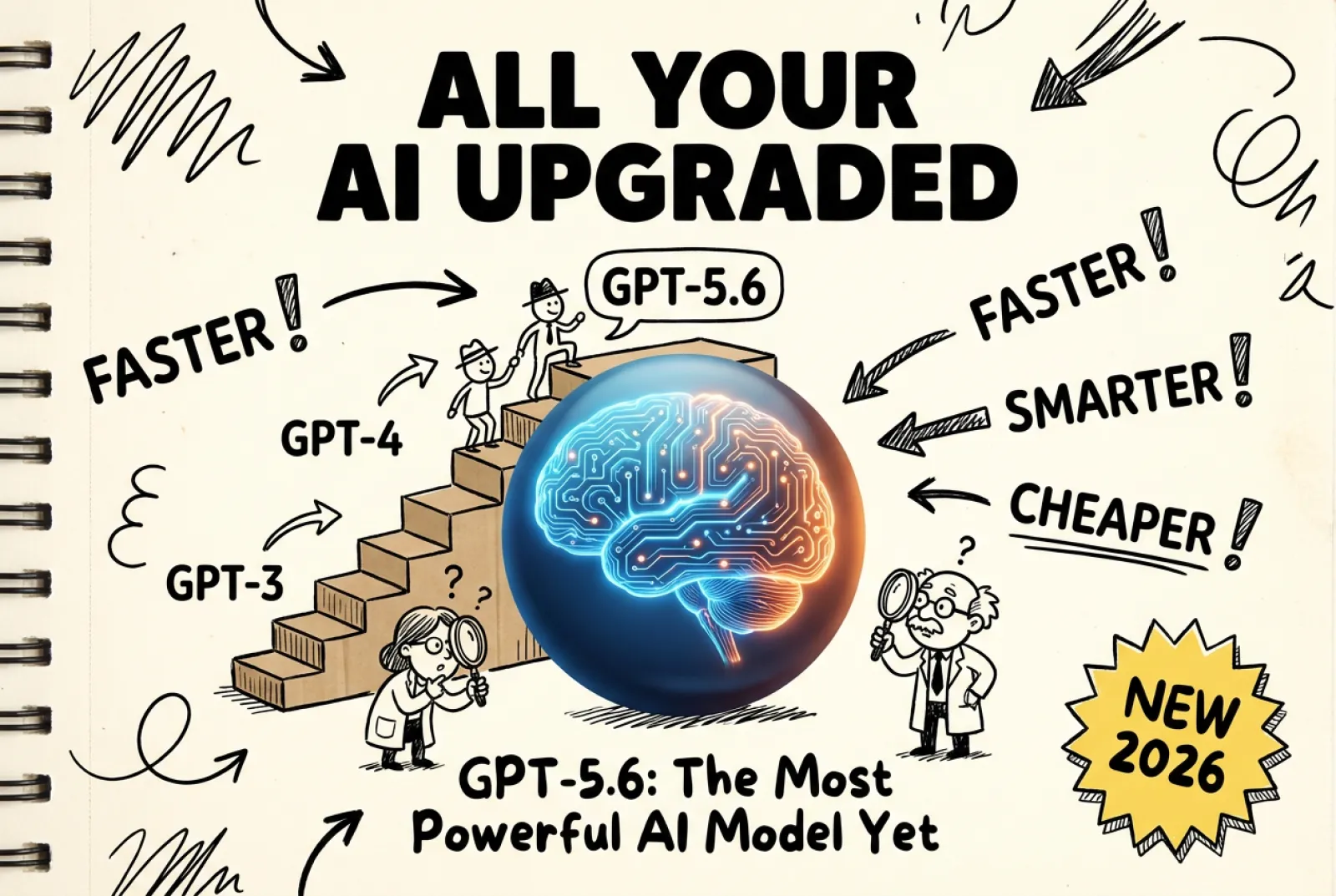
To appreciate what GPT-5.6 represents, it helps to trace the journey. GPT-3 impressed the world with coherent text generation but hallucinated facts at an alarming rate. GPT-4 brought multimodal input and dramatically better reasoning. GPT-4o added real-time audio and vision. GPT-5 pushed further on complex reasoning tasks.
GPT-5.6 closes the gap between "impressive demo" and "production-ready professional tool." Each new tier of capability hasn't just made AI smarter — it has unlocked entirely new use cases, from autonomous research agents to real-time design assistance.
Key Features of GPT-5.6
Here are the four headline capabilities that make GPT-5.6 stand out from everything that came before it.
Extended Context Window — GPT-5.6 handles significantly more tokens per request, enabling analysis of entire codebases, long legal documents, or full research papers in a single prompt.
Superior Coding Ability — Early benchmarks show GPT-5.6 produces cleaner, more maintainable code with better error recovery than competing models. Engineers working on complex multi-file projects will feel the difference immediately.
Multimodal Reasoning — The model handles text, images, and documents together, enabling workflows where you can paste a screenshot of a UI and ask for both a critique and the code to improve it.
Competitive Pricing — OpenAI reportedly plans aggressive pricing on GPT-5.6 to trigger a price war with Anthropic, which could democratize access to frontier AI for smaller teams and individual creators.
Why Was GPT-5.6 Delayed? The US Government Story
The US government — specifically under the Trump administration — requested that OpenAI adopt a phased release strategy for GPT-5.6, citing concerns about the model's ability to automate high-skill work, including advanced cybersecurity tasks. Rather than a public launch, only a small number of pre-approved enterprise partners initially received access.
According to The Verge's reporting, this scrutiny is more intense than what most AI competitors have faced. Sam Altman confirmed the approval process publicly, signaling that government oversight of frontier AI is now a real operational reality.

How to Use GPT-5.6 to Upgrade Your Workflow
You don't need to wait for full public access to start preparing. The most effective way to hit the ground running with GPT-5.6 is building workflows today that are ready to scale with its capabilities tomorrow.
Start with detailed system prompts — GPT-5.6's expanded context window rewards specificity. For visual and creative work, combine GPT-5.6's reasoning with a dedicated image platform like iMini AI, where you can generate, edit, and iterate on visuals alongside your text workflow.
Creating AI Images with GPT-5.6: A Prompt Example
One area where GPT-5.6 immediately shines is crafting detailed image generation prompts. Here's an example of a prompt style that consistently produces high-quality tech editorial visuals on platforms like iMini AI:
Futuristic AI assistant interface visualization, purple-blue gradient background, holographic chat UI floating panels in space, glowing conversation bubbles between human and AI, neural network pattern overlay, glassmorphism cards showing AI processing text and code, isometric 3D perspective, modern SaaS illustration style, clean tech aesthetic, soft purple glow, 16:9 landscape

About iMini AI
iMini AI is an all-in-one creative AI platform that brings the world's leading models together in a single workspace — including GPT, Claude, Gemini, and Google's Nano Banana series. Instead of juggling multiple tools and subscriptions, you get everything in one place.
With iMini AI, you can generate images using state-of-the-art models like Nano Banana Pro and Seedream 4.0, create AI videos with Sora 2 and Kling, build presentations from scratch, and collaborate on an infinite canvas. It's built for the way modern creators actually work: fast, multi-modal, and context-switching between tasks constantly.
As AI models like GPT-5.6 become more powerful, platforms like iMini AI become the connective tissue — the place where you bring those capabilities together and actually ship creative work at scale.
The Future of AI After GPT-5.6
GPT-5.6 is a signal, not a destination. We're entering an era where AI stops being a novelty and becomes critical infrastructure — embedded in how we write, code, design, and make decisions.
The competitive advantage is shifting. It's no longer about whether you use AI. It's about how intelligently you combine models, tools, and workflows to produce results no single model could achieve alone.

Conclusion
GPT-5.6 arrives as the most capable — and most scrutinized — AI model in OpenAI's history. Its extended context, superior coding, and multimodal reasoning represent a genuine leap forward, and its government-reviewed rollout signals that we've crossed a threshold where AI capability has real-world policy implications.
While you wait for full access, start building smarter AI habits today. Explore what's possible on iMini AI — the platform that brings GPT, Claude, Gemini, and powerful image and video generation together in one place.