
Claude Opus 5 vs GPT-5.6 vs Gemini 3.6 Flash: 2026 AI Model Comparison
July 29, 2026
The AI model race in 2026 looks very different from the one we watched in 2023 and 2024. Back then, the obvious question was: which model is the smartest? Today, that question is too simple.
For most teams, the better question is:
Which model gives me the best result for my workflow, budget, latency target, and safety requirements?
That is why the comparison between Claude Opus 5, GPT-5.6, and Gemini 3.6 Flash matters. These models represent three different philosophies:
- Claude Opus 5 is built for high-quality professional work, coding, and business reasoning with a strong emphasis on usability and controllable effort.
- GPT-5.6 is OpenAI's frontier model family, designed to scale from efficient everyday work to demanding reasoning, coding, cybersecurity, science, computer-use, and design tasks.
- Gemini 3.6 Flash is Google's production-ready fast model for agentic, multimodal, and high-volume workflows, with a very large context window and built-in tool support.
There is no universal winner. But there is a best choice for each type of job.
Quick Comparison
| Model | Best for | Main advantage | Watch out for |
|---|---|---|---|
| Claude Opus 5 | Business writing, coding, complex office work, careful reasoning | Strong output quality and practical workflow fit | Availability, pricing, and platform details may vary by plan |
| GPT-5.6 | Frontier reasoning, coding, science, cybersecurity, design, difficult knowledge work | Strong general capability with multiple model tiers | Higher-end tiers can be expensive for heavy workloads |
| Gemini 3.6 Flash | Agents, coding loops, multimodal tasks, high-volume automation | Speed, cost efficiency, 1M-token context, built-in tools | Some API behavior changes require migration work |
What Changed in 2026?
The most important shift is that top AI labs are no longer shipping only one flagship model and asking everyone to use it. They are shipping families of models and asking users to choose based on task difficulty.
OpenAI's GPT-5.6 family includes Sol, the flagship model, plus Terra for balanced everyday work and Luna for cost-sensitive use. Google's Gemini 3.6 Flash is positioned as a production model for fast agentic and multimodal workflows. Anthropic's Opus 5 focuses on making high-end Claude capability more efficient for daily business and programming tasks.
In practical terms, this means the best AI stack in 2026 may use more than one model:
- a strong reasoning model for hard decisions,
- a fast model for repetitive agent steps,
- a cheaper model for summarization and extraction,
- and a specialist model for coding, cyber, or multimodal tasks.
Claude Opus 5: Best for Polished Knowledge Work and Coding
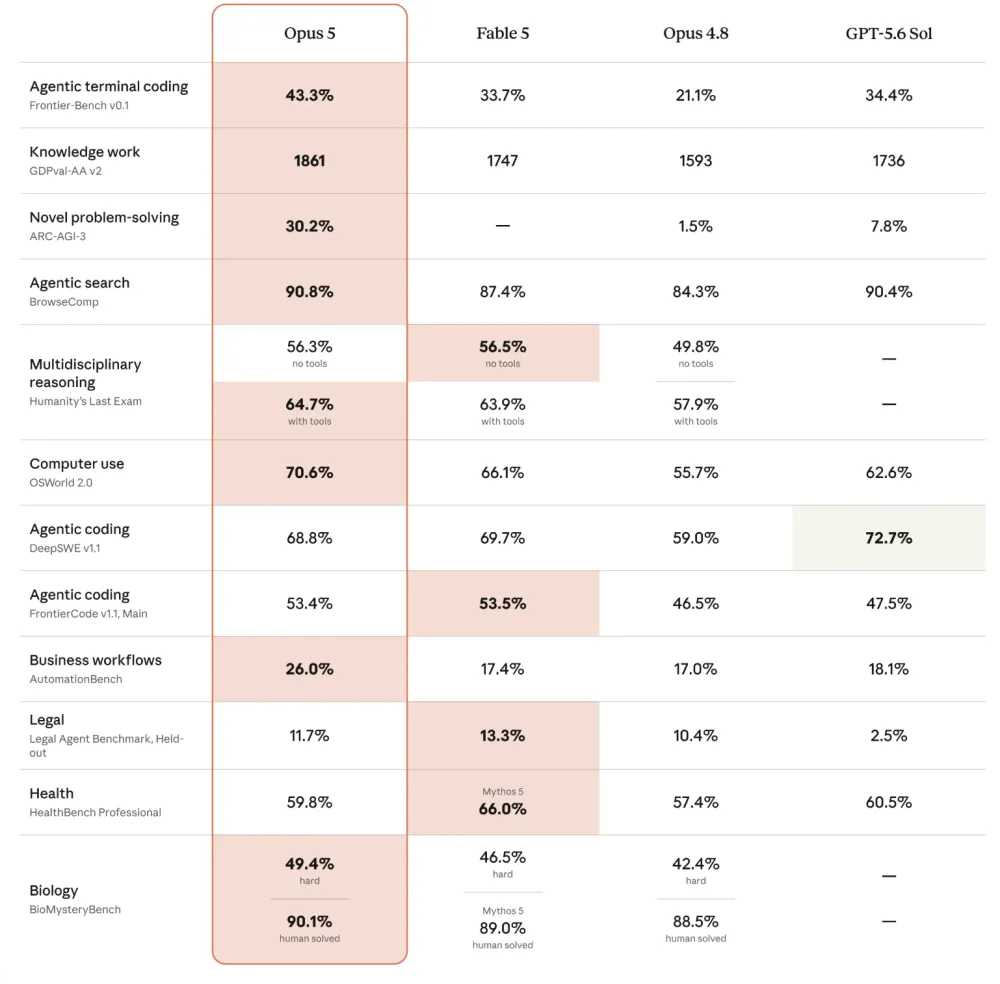
Claude Opus 5 is especially interesting because it sits between everyday assistant use and frontier-level autonomous work. The Verge reported that Anthropic positioned Opus 5 as a more efficient model for daily office and programming tasks, close to the capabilities of Fable 5 but at lower cost. Anthropic's platform documentation also lists claude-opus-5 as an active model.
Where Claude Opus 5 shines:
- writing that needs judgment, tone, and structure,
- coding tasks that require careful step-by-step reasoning,
- business documents, strategy memos, and analysis,
- workflows where users want fewer correction loops,
- tasks where reliability matters more than raw speed.
Claude has historically been strong at long-form writing and thoughtful analysis, and Opus 5 appears to continue that direction. For content teams, consultants, product managers, and developers, it may be the best "quality first" choice.
The tradeoff is that Claude is not always the cheapest option for large-volume automation. If your system needs to run thousands of small background tasks, you may want to reserve Opus 5 for the parts where judgment and quality matter most.
GPT-5.6: Best for Frontier Work and Broad Capability
OpenAI's GPT-5.6 launch frames the model family around a simple promise: more intelligence per token, better performance per dollar, and stronger capability on demand for hard work. GPT-5.6 includes Sol, Terra, and Luna, giving teams several options instead of forcing every workload onto the same model.
GPT-5.6 is especially relevant for:
- complex coding and software engineering,
- research and scientific analysis,
- cybersecurity and high-risk technical work,
- design and product thinking,
- computer-use tasks,
- multi-step knowledge workflows.
The biggest advantage of GPT-5.6 is breadth. If your team wants one model family that can handle many categories of work, GPT-5.6 is the safest default to evaluate first.
The practical question is cost control. Frontier models can be overkill for simple tasks. A good GPT-5.6 strategy is to route work by difficulty: use Sol for the hardest reasoning, Terra for most production workflows, and Luna for cost-sensitive tasks.
Gemini 3.6 Flash: Best for Fast Agents and Multimodal Workflows
Gemini 3.6 Flash is one of the most important releases for developers because it is not only a chatbot model. Google's documentation positions it for code generation, agentic execution, spatial reasoning, multimodal tasks, and rapid agent loops.
The model supports text, image, video, audio, and PDF inputs, with a 1,048,576-token input limit and a 65,536-token output limit. It also supports tools such as code execution, computer use in preview, file search, function calling, structured outputs, search grounding, and URL context.
That makes Gemini 3.6 Flash compelling for:
- coding agents,
- document extraction,
- multimodal analysis,
- large-context research,
- repetitive automation,
- UI or browser-control workflows,
- high-volume enterprise pipelines.
The catch is migration. Google notes API changes around deprecated sampling parameters and model-turn validation. Developers moving from older Gemini versions should review those changes before upgrading production systems.
Which Model Is Best for Coding?
For coding, the answer depends on the shape of the job.
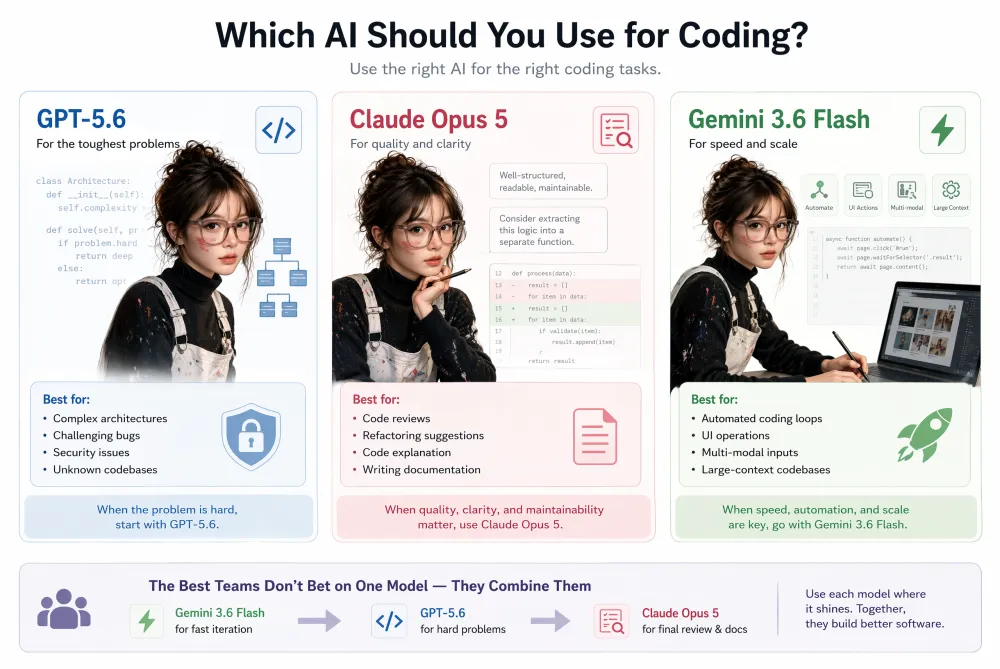
Choose GPT-5.6 when the work is difficult, open-ended, or involves architecture, debugging, security, or unfamiliar codebases.
Choose Claude Opus 5 when you want careful code review, readable explanations, strong refactoring judgment, or high-quality developer-facing writing.
Choose Gemini 3.6 Flash when you need fast coding loops, agentic UI automation, multimodal inputs, or very large context at a production-friendly cost.
For many engineering teams, the best setup is hybrid: Gemini 3.6 Flash for fast loops, GPT-5.6 for hard reasoning, and Claude Opus 5 for final review or high-quality documentation.
Which Model Is Best for Content and SEO?
For SEO content, Claude Opus 5 may be the strongest first draft model because it tends to produce polished, readable, structured writing. GPT-5.6 is excellent when the article requires deep analysis, technical accuracy, or multi-source synthesis. Gemini 3.6 Flash is useful when the workflow includes large input sets, PDFs, videos, transcripts, or automated content operations.
Recommended SEO workflow:
- Use Gemini 3.6 Flash to process large research files, competitor pages, transcripts, and raw notes.
- Use GPT-5.6 to build the argument, validate technical claims, and structure the article.
- Use Claude Opus 5 to polish tone, improve readability, and create localized versions.
Which Model Should Businesses Choose?
If you are a startup, begin with cost and speed. Gemini 3.6 Flash and GPT-5.6's cheaper tiers are likely to be more practical for daily automation.
If you are an agency or content team, prioritize output quality. Claude Opus 5 and GPT-5.6 are strong candidates.
If you are an enterprise, evaluate security, admin controls, auditability, data policy, latency, and model routing. The best choice may be a multi-model system rather than a single vendor.
Final Recommendation
Use Claude Opus 5 when quality, tone, and careful reasoning matter most.
Use GPT-5.6 when you need the strongest general-purpose frontier intelligence across coding, research, science, cybersecurity, and complex knowledge work.
Use Gemini 3.6 Flash when you need speed, large context, multimodal input, agentic workflows, and cost-efficient production automation.
The real winner in 2026 is not one model. It is the team that learns how to route the right task to the right model.
Sources
- OpenAI: GPT-5.6 launch and model release notes
- Google AI for Developers: Gemini 3.6 Flash model page
- The Verge: Anthropic releases Claude Opus 5