
How AI Agents Can Turn AI Topic Hunting into a Repeatable Content Workflow
The bottleneck is not writing, but deciding what deserves to exist
Most content teams do not run out of words. They run out of confidence. The market is noisy, the feed changes every hour, competitors publish similar angles, and every promising topic seems to expire before the team has finished the brief. The result is a strange kind of waste: people write more, but learn less about what the audience actually needs.
The best use of an AI Agent in topic hunting is not to replace taste. It is to make the material for judgment arrive earlier, cleaner, and with more context.
When iMini is added to this system, the workflow does not stop at a topic list. A validated idea can become a blog cover, a workflow diagram, a social carousel, an ad concept, a short-video thumbnail set, or a product education image. The Agent helps the team decide what is worth making; iMini helps the team make enough versions to test the angle properly.
Turn topic selection from inspiration into a workflow
A weak topic process usually starts with a blank document and a question: what should we write this week? A stronger process starts before the meeting. It continuously collects small pieces of demand: repeated questions, searches that keep rising, comments that sound confused, complaints about existing tools, and competitor explanations that leave a gap.
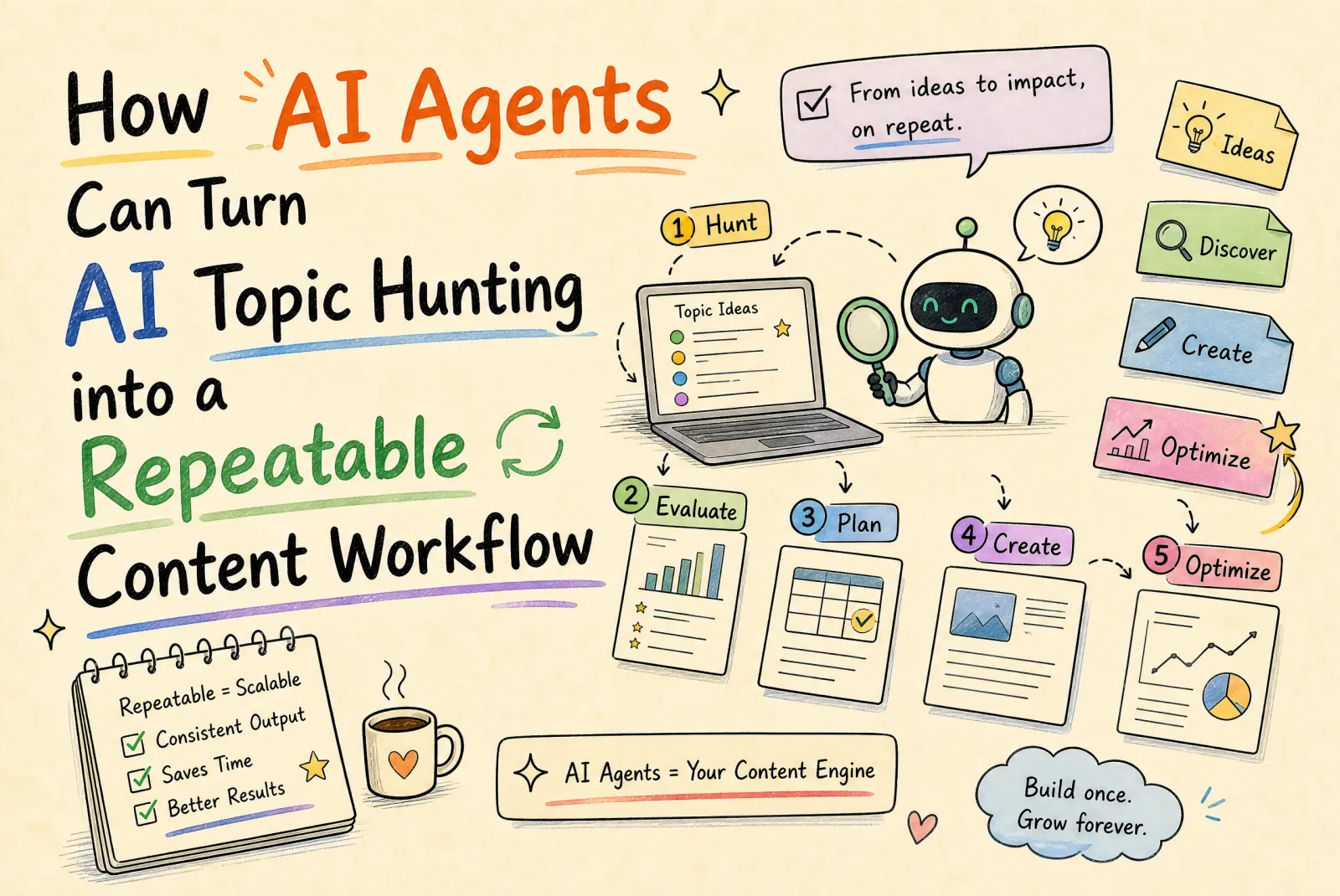
AI topic hunting means building a repeatable loop around those signals. The loop has four jobs: collect, cluster, score, and package. Collection makes the team less blind. Clustering turns scattered observations into topic families. Scoring prevents the loudest trend from winning automatically. Packaging turns the selected idea into a brief that iMini can use for visual production.
- Collect: bring signals from search, social, communities, competitors, and product feedback into one review rhythm.
- Cluster: group similar questions so the team can see demand patterns rather than isolated posts.
- Score: compare ideas by relevance, urgency, originality, visual value, product fit, and production cost.
- Package: turn the chosen topic into an iMini creative brief with hooks, claims, examples, and visual directions.
Step 1: Give the Agent a precise hunting brief
A vague prompt such as “find viral AI topics” will usually produce generic output. The Agent needs boundaries before it can be useful. Define the audience, the product context, the themes worth watching, the themes to ignore, the tone of the brand, and the asset formats the team can actually ship.
For an iMini team, the hunting brief might include AI image generation, AI video creation, creator workflows, product marketing, prompt design, social growth, design automation, AI Agent operations, and visual storytelling. It should exclude generic AI news unless the news changes how creators, marketers, or product teams actually work.
A clear brief turns the Agent from a random headline generator into a focused research assistant.
Step 2: Collect signals from different layers of demand
Good topics almost never come from one source. A viral post shows attention, but search data shows intent. A comment thread reveals pain, but competitor content reveals which framing is already overused. Product support conversations show where people fail in practice, while product usage patterns show what people are trying to do repeatedly.
- Social signals: saves, replies, quote posts, reposts, creator debates, and repeated hook formats.
- Search signals: how-to queries, comparison searches, alternative searches, definitions, and troubleshooting intent.
- Community signals: questions in comments, Discord groups, forums, product communities, review sections, and niche newsletters.
- Competitor signals: feature pages, new launches, article structures, weak explanations, and repeated claims.
- Product signals: support tickets, onboarding friction, abandoned workflows, feature adoption, and customer language.
The important part is not the number of sources. It is the separation of signal types. Attention, intent, pain, and product fit should not be collapsed too early. The Agent should keep evidence visible so the editor can understand why a topic is being recommended.
Step 3: Set a threshold before a topic enters the pool
Without a threshold, every interesting observation becomes a candidate. That creates a new problem: the team spends the meeting filtering noise created by the automation. A better approach is to define minimum conditions. For example, a topic might need signals from at least two layers, one clear audience pain, one product connection, and one visual production route before it enters the topic pool.
This threshold is especially important for AI content because the field is full of recycled news. A model release may be popular, but if the team cannot explain what a creator should do differently tomorrow, the topic may not deserve production. The Agent should be trained to ask: what changes for the user, and what can iMini help them make?
Step 4: Score ideas before anyone starts producing
Once the Agent has a clean pool, the team needs a simple scoring model. The goal is not to make editorial judgment mechanical. The goal is to make trade-offs visible. A topic with high urgency but weak product fit may be useful for a social post, but not for a product-led article. A topic with strong search intent and strong visual value may deserve a deeper guide.
- Audience relevance: does the target reader care about this now?
- Urgency: is there a reason to publish soon instead of later?
- Originality: can the brand add judgment, workflow, examples, or data?
- Visual value: can the idea become a diagram, cover, carousel, ad, or thumbnail set?
- Product fit: can iMini genuinely help the reader act on the idea?
- Production cost: can the team ship a strong version quickly enough?
The best topics are often not the loudest trends. They are medium-sized problems with very clear intent. These topics can work across search, social, product education, and ads because the audience already knows the pain, but has not yet seen a useful way to solve it.
Step 5: Turn the topic into an iMini creative brief
After scoring, the Agent should not write the final article immediately. It should produce a creative brief. A useful brief includes the reader, the situation, the tension, the core claim, the supporting points, likely objections, examples, and suggested visuals. This is the bridge between research and production.
For example, a topic such as “AI Agents for creator topic hunting” can become an iMini brief with a workflow diagram, a blog cover, a set of social cards, and three visual metaphors to test. One metaphor might show a radar scanning weak signals. Another might show a messy feed turning into a ranked topic board. A third might show topic ideas moving into visual production.
- Article assets: hero image, section diagrams, comparison tables, and explanatory graphics.
- Social assets: carousel slides, X images, LinkedIn visual posts, and creator-friendly summaries.
- Ad assets: hook variants, product-scene visuals, campaign concepts, and thumbnail tests.
- Product education: onboarding graphics, workflow templates, feature cards, and use-case visuals.
Step 6: Test the angle, not only the finished asset
The first version of a topic is a hypothesis. The team is not only testing whether a cover looks good. It is testing whether the audience responds to the framing. Does the same idea perform better as productivity advice, creator-growth advice, research automation, or visual content strategy? iMini makes this test practical because one brief can produce multiple visual directions.
After publishing, the results should return to the Agent. High saves may indicate practical value. Comments may reveal missing explanations. Click-through may show whether the promise was clear. Weak performance may mean the topic was wrong, but it may also mean the hook or visual metaphor was too abstract. The workflow improves only when production results become new research signals.
When automation should slow down
AI topic hunting should not become a machine for chasing every spike. Some topics are too sensitive, too shallow, or too disconnected from the product. Some trends are popular because everyone is repeating them, not because the audience needs another explanation. The human editor should protect the brand from publishing just because the dashboard says a phrase is rising.
A good rule is simple: automate sensing, not responsibility. Let the Agent notice more than a person can manually watch. Let iMini help create more versions than a designer can manually mock up from scratch. But keep the final call with the team that understands the reader, the product, and the cost of publishing something forgettable.
About iMini
iMini is an AI creative workspace for creators, marketers, and product teams. It brings image generation, image editing, canvas-based creation, and multi-model workflows into one production environment. In an AI topic-hunting workflow, iMini is the creative layer that turns validated insight into publishable assets. It helps teams move from “we found a topic” to “we have a cover, a diagram, social variants, and a campaign direction we can test.”
FAQ
Is AI topic hunting the same as asking AI for blog ideas?
No. Asking for blog ideas is a one-time brainstorming task. AI topic hunting is a continuous workflow that collects signals, clusters patterns, scores opportunities, and turns the strongest topics into production briefs.
Should the Agent decide what to publish?
No. The Agent should recommend and explain. Human editors should make the final call because they understand taste, timing, brand risk, and strategic priority.
Where does iMini add the most value?
iMini adds value after a topic has been validated. It helps the team turn a brief into covers, workflow diagrams, social creatives, ad concepts, and product education assets.
How often should this workflow run?
For fast-moving AI and creator markets, daily signal collection and weekly editorial review is a practical rhythm. Evergreen topics can be reviewed monthly, but fast signals should be captured more often.
Conclusion
AI topic hunting is not about replacing editorial judgment. It is about giving judgment better evidence and giving production a faster path from idea to asset. The Agent expands the research surface. The team chooses the angle. iMini turns the chosen topic into visuals that can be published, tested, and improved. Together, they create a content system that is faster than manual research and more deliberate than random inspiration.