
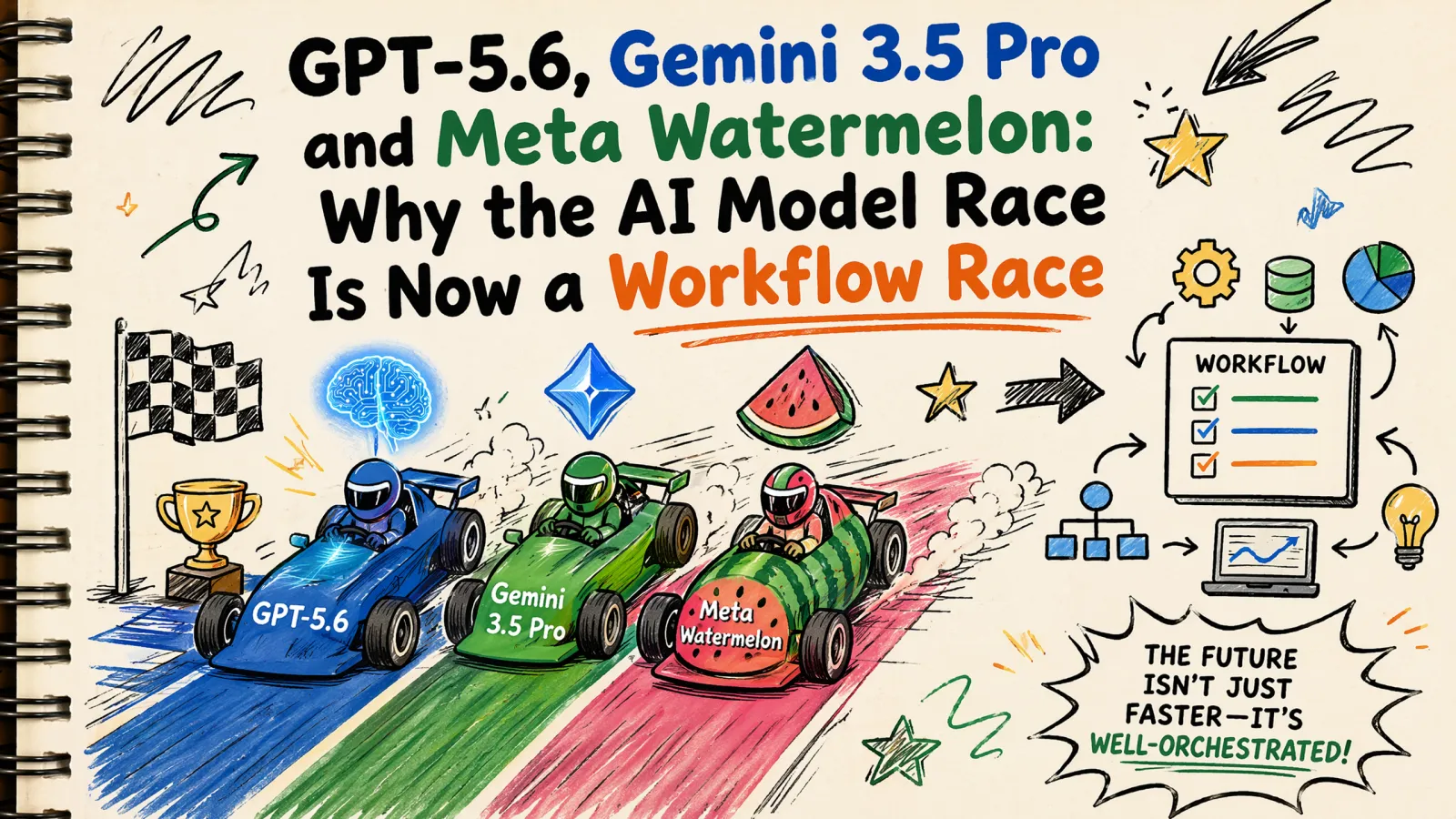
GPT-5.6, Gemini 3.5 Pro and Meta Watermelon: Why the AI Model Race Is Now a Workflow Race
July 6, 2026
The AI model race is no longer just a scoreboard of bigger benchmarks and louder launch rumors. For creators, marketers, and small product teams, the real question is becoming more practical: when GPT-5.6, Gemini 3.5 Pro, Meta's reported Watermelon model, video generators, and AI agents all evolve at once, how do you turn that noise into a usable production system?
The answer is not blind loyalty to a single model. The teams that move fastest in 2026 will treat models like specialist collaborators: one for reasoning, one for visual direction, one for video planning, one for agentic execution, and one platform to keep the campaign coherent.
GPT-5.6, Gemini 3.5 Pro and Meta Watermelon Are Signals, Not Just Headlines
The current conversation around GPT-5.6 centers on access, safety, coding strength, and whether frontier capability will arrive through limited release before broad availability. Gemini 3.5 Pro is being watched for longer tasks, stronger multimodal reasoning, and deeper agent workflows. Meta's Watermelon reports matter because they show how seriously open and closed ecosystems are competing for the next performance jump.
These names are useful SEO keywords, but they are also a map of where the market is going. The industry is moving from “Which model is smartest?” to “Which system can route work to the right model without breaking the creative process?”

The Best AI Stack Is Becoming a Model Mix
A campaign rarely needs one kind of intelligence. Strategy needs reasoning, product positioning needs taste, search content needs structure, image generation needs composition, video planning needs motion logic, and localization needs cultural fluency. Asking one model to do all of that is convenient, but it is not always the highest-quality route.
A multi-model AI workflow lets a team separate the job into stronger parts. You might use a reasoning model to sharpen the angle, a visual model to explore campaign worlds, an agent to create variants, and a review step to compare outputs before publishing.

AI Agents Are Turning Model Choice Into Workflow Design
The agent shift is important because it changes AI from a chat interface into a production layer. A useful agent does not only answer a question; it carries work across research, draft, image direction, prompt testing, versioning, localization, and publishing preparation.
This is why the model race and the workflow race are now connected. Better models raise the ceiling, but agents decide whether that capability becomes a finished asset or remains a nice demo inside a chat window.

Creative Teams Need Modular Outputs, Not One-Off Generations
Modern content production is modular. A single campaign may need a blog title, a hero image, three social hooks, a short video concept, a landing-page visual, email copy, localized headlines, and multiple image ratios. The winning workflow treats each asset as a module that can be regenerated, compared, or localized without restarting the whole project.
That modular habit is what makes model upgrades useful. If Gemini gets better at long context, use it for planning. If GPT improves agentic coding or structured reasoning, route the operations work there. If a visual model gets stronger at composition, refresh the creative assets while keeping the strategy intact.

Compute Is the Quiet Force Behind the AI Model Race
The compute boom is not background noise. AI chips, specialized inference hardware, and cloud capacity shape what creators can actually do: more variations, faster previews, richer video tests, longer agent runs, and cheaper experimentation.
When compute becomes faster and more specialized, creative workflows change. Teams can test ten directions instead of two, localize earlier, compare visuals before a meeting, and replace slow approval cycles with sharper iteration loops.

Where iMini Fits: One Creative Control Room for Many Models
iMini is useful in this shift because the model race creates a coordination problem. Creators do not only need another empty prompt box; they need a place to turn research, writing, images, videos, and campaign decisions into one continuous workflow.
Think of iMini as a creative control room. The point is not to replace human taste. The point is to reduce the friction between idea, model choice, visual testing, localized copy, and the final assets a team can actually use.
How to Build a Future-Proof AI Workflow
Start by separating your workflow into repeatable stages: research, angle, structure, visual direction, asset generation, review, localization, and publishing. Then decide which model type is best for each stage instead of forcing every task through the same system.
Keep prompt templates, winning visual directions, and approved brand language in reusable form. When GPT-5.6, Gemini 3.5 Pro, Meta Watermelon, or another new model changes the market, you can upgrade the relevant step without rebuilding the entire process.
Conclusion
The AI model race still matters, but the model with the loudest headline will not automatically create the strongest campaign. The durable advantage belongs to teams that can combine models, agents, and creative judgment inside a workflow that keeps moving.
That is the real shift behind GPT-5.6, Gemini 3.5 Pro, Meta Watermelon, AI agents, and the compute boom: model power is becoming workflow power.