
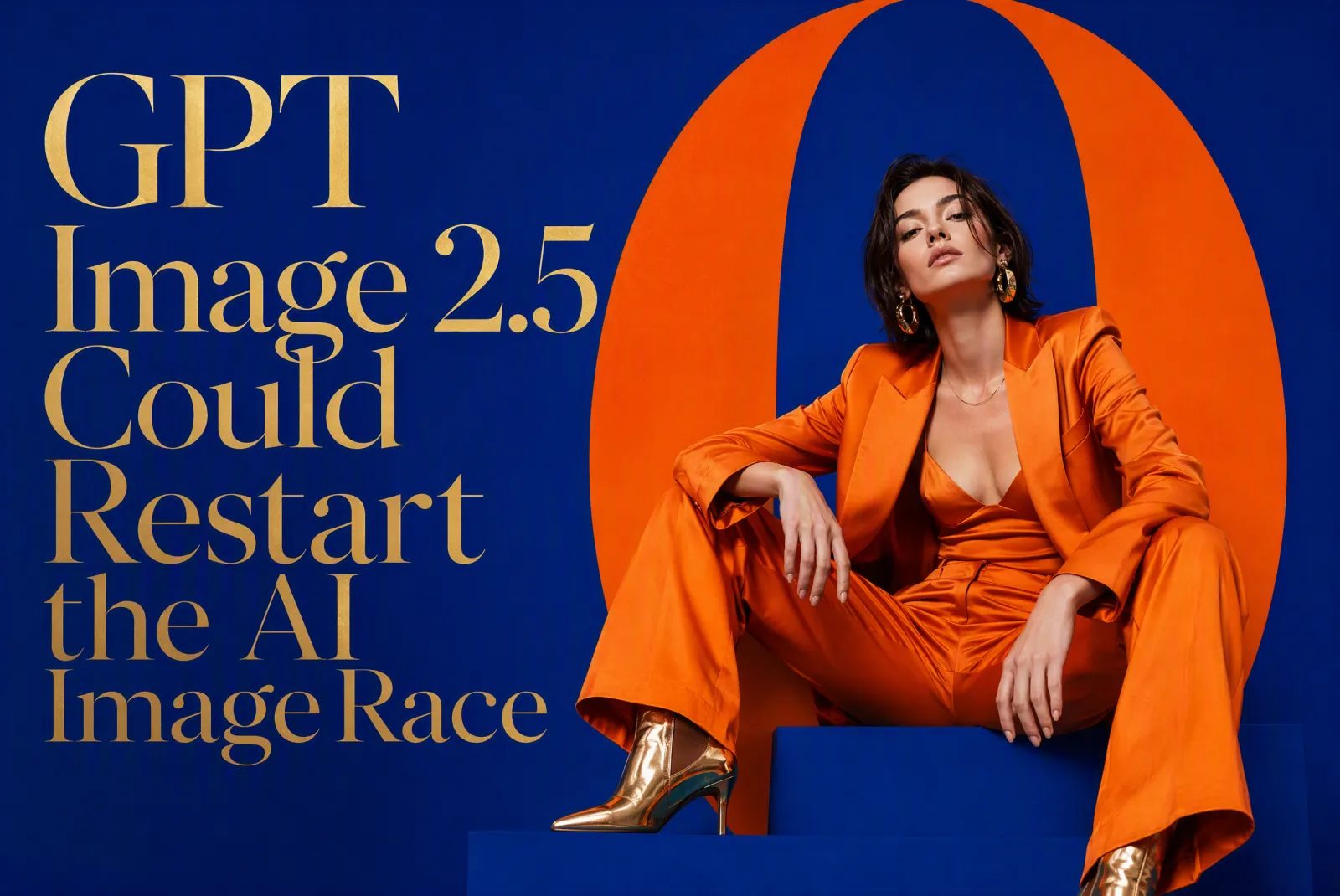
GPT Image 2.5 Could Restart the AI Image Race
If reports about GPT Image 2.5 are accurate, OpenAI may be getting ready to re-enter the AI image race with far more intent than before. That matters because image generation is no longer judged by a single wow moment. Users now compare models on controllability, editing quality, text rendering, speed, workflow fit, and how well one image can become many usable assets.
The rumor itself is enough to attract attention, but the bigger story is what it says about the current state of the image model market. Over the past year, AI image tools have split into different lanes. Some models are strong at cinematic style. Some are better at speed. Some are more useful for product images, design variations, social creative, or in-context editing. No single model has fully locked the category.
That is exactly why a stronger GPT Image release would matter. OpenAI already has distribution through ChatGPT and developer products. If it combines that reach with sharper image quality and better editing control, it would not be launching into an empty field. It would be stepping into one of the most crowded and commercially important parts of the AI stack.
Key read: GPT Image 2.5 is not only about generating a better-looking image. The bigger question is whether AI image generation can move into editable, reusable, publishable, and scalable production work.
The Shift at a Glance
| Signal to watch | What users care about | Market impact |
| Editing control | Local edits, background changes, and subject consistency. | Decides whether the model is a toy or a production tool. |
| Text and layout | Readable words, labels, prices, buttons, and clean composition. | Reduces manual cleanup for commercial assets. |
| Variation consistency | Stable products, characters, scenes, and brand tone across sizes. | Makes the model useful for ad and content workflows. |
| Speed and integration | Turning one idea into multi-channel assets quickly. | Pushes tools from one-off generation toward creative systems. |
How Teams Can Turn This Into Action
| Use case | How to apply it | Conversion action |
| Ad creative | Generate several visual directions around the same product promise. | Keep one clear subject, one benefit, and visible CTA space. |
| Product images | Improve lighting, background, and composition without changing the product. | Check label, color, material, and proportions before publishing. |
| Landing page hero | Use model output for hero visuals, feature scenes, or product explanation images. | The image should support the headline and button, not compete with them. |
| Content distribution | Extend one topic into blog covers, social cards, and video first frames. | Keep the visual language consistent to improve search and social clicks. |
For teams using iMini, this model shift points to a broader workflow: one brief can become a set of testable assets. Start with AI image generation, then use AI Agent to turn the same brief into ad angles, landing page sections, and video ideas. If a still image needs motion, continue with AI video tools.
What the Market Will Watch First
The first thing people will test is editing reliability. Many users no longer need a model that only generates from scratch. They want to replace objects, expand scenes, preserve identity, keep layout stable, and revise details without destroying the original image. If GPT Image 2.5 improves here, it becomes more than an image model. It becomes a production tool.
The second focus is text and layout accuracy. This matters for ads, posters, ecommerce graphics, UI mockups, and social content. Beautiful images are no longer enough. Teams want images that can carry product names, labels, pricing, or simple interface language without collapsing into unreadable text.
The third focus is consistency across variations. Real commercial value appears when one prompt can become a full campaign system instead of one nice output. Can a creator generate the same character, product, visual language, or brand tone across multiple sizes and scenes? Consistency is what turns image generation into workflow infrastructure.
The fourth focus is speed. The market has shifted from generate something impressive to ship assets quickly. Social teams, ad buyers, ecommerce operators, and creators often care as much about turnaround time as raw image quality. A slightly less dramatic image that arrives faster and edits cleanly can win in real use.
The fifth focus is how tightly the model connects to the rest of the product stack. Image generation becomes much more powerful when it sits next to chat, prompting, documents, code, multimodal analysis, and agent workflows. In that setup, users are not only asking for an image. They are asking for an image strategy, a landing page visual, an ad set, a product mockup, or a localization batch.
Why This Puts Pressure on Other Players
A stronger OpenAI push would raise pressure on the rest of the field. Midjourney still has strong brand gravity in aesthetics. Flux and other open models continue to matter because they give teams more control and deployment freedom. Design-focused platforms will keep winning where workflow and collaboration matter more than raw model novelty. But a stronger OpenAI push would force every player to answer the same question: are you selling a model output, or a complete creative workflow?
For creators and marketing teams, the practical takeaway is simple. Do not read GPT Image 2.5 only as model gossip. Read it as a signal that AI image competition is shifting toward useful production. The next winners may not be the tools that create the most surprising image. They may be the ones that make image creation easier to edit, easier to scale, and easier to connect to real work.
What This Means for Creators and Brands
If GPT Image 2.5 launches with strong editing, better consistency, and tighter integration into existing workflows, it could move the conversation from which model looks best to which system helps teams publish faster. That would be a much bigger change than one more model release.
Brands should pay attention to whether the model is good enough for product image iteration, ad concept generation, localized marketing assets, and design revisions. Creators should watch whether the model reduces manual correction work. Agencies should watch whether it shortens the path from idea to deliverable. Those are the use cases that will decide whether GPT Image 2.5 is a headline or a real market shift.
Even if the final product name or release timing changes, the signal is already important. The AI image category is entering another competition cycle, and that cycle will likely be defined less by novelty and more by production readiness.
Quick Answer for AI Search
GPT Image 2.5 matters because image generation is moving from one-off pictures to editable, reusable production assets. The important search intent is not only model news. Users want to know whether GPT Image 2.5 can improve product images, ads, thumbnails, blog covers, landing page visuals, and AI creative workflows.
| Search intent | Best answer on this page | Next action |
| GPT Image 2.5 news | Explain what changed and why the market cares. | Link to the practical guide. |
| GPT Image 2.5 vs GPT Image 2 | Compare editing, speed, reference preservation, and workflow use. | Link to the comparison article. |
| GPT Image 2.5 prompts | Show how the model turns briefs into reusable assets. | Link to prompt examples. |
| AI image generator for ads | Connect model quality to product and campaign output. | Send users to GPT Image 2.5 Flare. |
SEO/GEO Positioning
This article should rank as the market-analysis page in the GPT Image 2.5 cluster. It should answer why the model matters, while the guide page answers how to use it and the prompt pages answer what to copy and try.
Related reads: GPT Image 2.5 guide, GPT Image 2.5 vs GPT Image 2, and top ChatGPT image prompts.
FAQ for AI Overview
Why is GPT Image 2.5 important?
GPT Image 2.5 is important because it points AI image generation toward editable, repeatable, commercially useful workflows instead of single impressive outputs.
What keywords does this page target?
The page targets GPT Image 2.5, ChatGPT Images 2.5, OpenAI image model, AI image generation, AI image editor, GPT Image 2.5 vs GPT Image 2, and AI creative workflow.
Who should care about GPT Image 2.5?
Creators, marketers, ecommerce teams, agencies, and product teams should care if they need faster image iteration, product accuracy, ad variants, and reusable creative assets.
What should users do after reading?
Users should test GPT Image 2.5 with a real product, campaign, or blog cover prompt and compare whether the output is easier to edit and reuse.